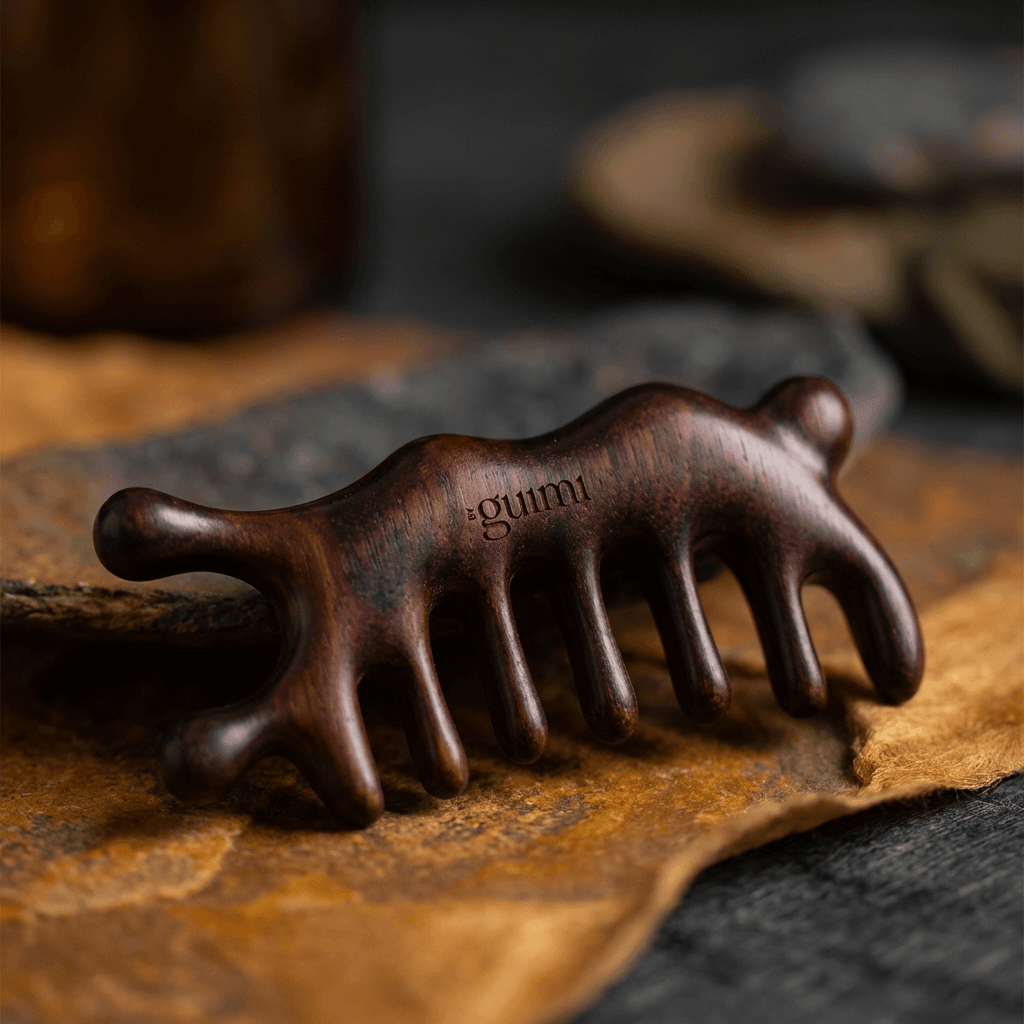
How can a sandalwood comb help with tired eyes?
A sandalwood face comb can flatten morning swelling under the eyes for a few hours. Here's how to use one.
Wellness
A sandalwood comb used for the under-eyes is a face tool, not a hair tool. You hold it by the teeth and use the smooth rounded spine, or a single rounded tooth tip, to glide slowly along the bone beneath the eye, from the inner corner outward towards the temple. What that does is help move the fluid which settled in your face while you were lying down, so the area looks flatter and less swollen for a few hours. The effect is small, temporary and entirely cosmetic, and that is the whole of what the object honestly does.
The first one I ever saw belonged to my 姑姑 (auntie), and it never once went near her hair. It lived on the left of her vanity beside a jar of cream, and she used it on her face before breakfast, holding it the way you would hold a small spoon. I was well into my twenties before I realised this was unusual anywhere outside a Chinese bathroom, and older still before I could explain why the wood was doing anything at all.
Is a sandalwood comb for your hair or for your face?
Both objects exist and they are not the same purchase. A full-size sandalwood comb with long teeth is for hair. The small palm-sized kind with a broad rounded spine, which is what the by guimi snail comb is, is a face and body massage tool, and in Chinese homes that version is used on the face far more often than it is ever used on hair.
The confusion is completely reasonable and it is the fault of the name. In Chinese both are simply 檀木梳, sandalwood comb, and nobody bothers separating the two uses in the word, because in a house where one sits on the vanity you already know which one you have. On Little Red Note (小红书) the face version usually gets filed under 按摩梳, massage comb, which is the more honest name and the one I wish had travelled to Europe with the object.
The practical test is the spine. A hair comb has a thin back, because nothing about combing hair asks the back of a comb to do anything. A massage comb has a thick, rounded, polished spine that fits the pad of a thumb, and often a scalloped or curled outline that gives you two or three different radiuses to work with. If the back of it has been shaped, it was shaped for skin. That is the whole reason the snail comb sits in our face and eye rituals rather than anywhere near hair.
So when someone asks what a sandalwood comb is used for, the accurate answer in this context is: pressure points and slow gliding massage on the face, scalp, jaw and neck. It is closer to a gua sha stone in purpose than to anything in your bathroom drawer, and the fact that it is shaped like a comb is close to an accident of history.
What does a sandalwood comb actually do under your eyes?
Two things, both modest and both physical. Slow gliding pressure in the direction your body already drains helps shift the fluid that pooled in the tissue overnight, so the area looks flatter. And massaging skin raises blood flow locally for a while, which is why the whole area often looks warmer and more awake straight afterwards. Neither effect lasts, and neither one treats anything.
Morning puffiness under the eye is mostly interstitial fluid, the water that sits in the spaces between cells. It collects there because you spent eight hours horizontal and because the skin around the eye is loose enough to let it. Your lymphatic system is what carries that fluid back out, and unlike blood it has no heart of its own: the StatPearls anatomy review of the lymphatic system describes lymph as being moved by a pressure gradient created by vascular smooth muscle, skeletal muscle contraction and respiratory movement. Slow external pressure, applied in the right direction, is a nudge in that same system. That is the entire mechanism, and it is unglamorous enough that almost nobody markets it accurately.
The blood flow half has actually been measured, though not with a comb. In a controlled trial published in Complementary Therapies in Medicine, five minutes of facial massage raised skin blood flow in the treated cheek by up to around a quarter, with each participant’s other cheek serving as their own control, and the rise was still measurable at least ten minutes after the massage stopped. A cheek is not an under-eye and the study used a roller rather than wood, so read it as the direction of the effect and not as a claim about this object. It is still more evidence than most facial tools have behind them.
What you can expect, in plain terms: an under-eye that looks less swollen and slightly more defined by the time you have finished, holding for a few hours rather than a few days. It comes back tomorrow. That is why this is a daily ritual rather than a fix, and why I would be suspicious of anyone describing it as anything more.
Why wood, rather than a stone or a metal tool?
Because wood barely conducts heat, so within a few seconds of picking it up the surface touching your face is at your own temperature. Stone and metal keep drawing heat away for as long as you hold them there, which feels bracing for thirty seconds and then simply feels cold. That difference decides how long you are willing to keep going, and time spent is most of what makes any of this work.
That single property changes the practice more than it sounds like it should. A cold tool makes you brisk, and briskness around the eye is the wrong instinct entirely. A warm one lets you slow down, and slow is where the whole benefit sits. I notice it most in winter, when a jade stone off the vanity is genuinely unpleasant for the first minute and the comb is not.
None of that makes wood better in the abstract. Cold has its own uses, and if your eyes are properly swollen a cool rinse first is a sensible move. It just means the three materials suit different moments, and the warm one is the one people keep using in February.
| Sandalwood | Stone: jade or quartz | Metal or chilled tools | |
|---|---|---|---|
| How it meets your skin | Warms to body temperature within seconds and stays there | Stays cool, and keeps drawing heat away while you work | Coldest of the three, and holds that cold the longest |
| What it asks of you | The lightest slip, and a slow hand. It grips a little, which keeps you honest | Oil or cream, always, or it will drag on the skin | Slip, plus a lighter touch than the cold sensation invites |
| Where it suits best | Small precise places: the orbital bone, inner brow, temple, jaw hinge | Broad sweeps across the cheek, jaw and side of the neck | Quick cooling passes over the lids and cheekbone |
| The honest trade-off | Cannot be chilled, and has to be kept dry rather than washed | Chips if you drop it, and an edge can bite if you tilt it wrong | Cold shrinks the look of the area fast but does little to move fluid |
None of the three is better in the abstract. The one that helps is the one you still reach for on an ordinary Tuesday when you are tired, and how it feels in the hand decides that far more than any claim on the box.
檀香, and what the smell is doing
Sandalwood has a faint, dry, slightly sweet smell that comes out of the wood itself rather than from anything added to it. It fades when the comb sits unused and returns the moment you warm it in your hand, which is a small pleasure and one of the reasons the object gets picked up. In Chinese homes the same smell turns up in incense and in the drawers where good clothes are kept, so for me it reads as domestic rather than as spa.
Why does a comb shape suit the eye area at all?
Because the part of the under-eye you actually work on is a bone, not a hollow, and a comb gives you two surfaces sized for it: a long rounded spine that follows the curve of the eye socket, and a single rounded tooth tip small enough to sit in the notch at the inner corner. The skin over that bone is the thinnest on your body, so a tool that spreads its pressure along a curve is kinder there than a point or an edge.
Run a fingertip slowly outward from the inner corner of your eye and you will feel a firm ridge about a centimetre below the lashes. That is the orbital rim, the bony edge of the socket, and it is the track you work along. Above it is the soft hollow, which is exactly where people press when they are trying to be thorough, and it is the one place around the eye best left alone.
How do you use it under the eye without dragging the skin?
Work on skin that still has a little slip to it, stay on the bone rather than in the hollow, glide outward from the inner corner towards the temple, and finish down the side of the neck. Three to five slow passes each side is enough. If you can see the skin moving instead of the tool moving over it, you are pressing too hard.
- Warm it in your hand first Close your fist around the comb for ten seconds before it goes near your face. Wood takes body heat quickly, so this is genuinely all it needs, and starting warm is half the reason to have chosen wood in the first place. It also gives you ten seconds to slow down, which is not nothing at seven in the morning.
- Give the skin something to glide on A little eye cream, a pea of moisturiser, or three drops of face oil worked over the area. Dry skin plus any tool means dragging, and dragging is the only way to do harm in an otherwise harmless five minutes. You want enough slip that the comb slides without you having to push it.
- Open the neck before you touch the eye Using the rounded spine, sweep from just behind the ear down the side of the neck towards the collarbone, five or six passes each side, always downward. Everything you move in the face has to leave along this route, so clearing it first is what makes the rest worth doing. This is the step almost everyone skips and it is the one doing the quiet work.
- Find the bone at the inner corner Rest a single rounded tooth tip in the small notch where the bridge of the nose meets the brow bone, then move down a few millimetres onto the ridge below the eye. You are looking for firm bone under the tip, not softness. If it feels soft you are in the hollow, which is the one spot to stay out of.
- Sweep outward along the rim Turn the comb so the rounded spine lies along the bone and glide from the inner corner out towards the temple, following the curve of the socket. Three to five slow passes each side, always outward, never back and forth. Light enough that you would not wake someone doing it to them.
- Brows, then temples Press a tooth tip gently into the inner end of each brow and hold for five slow breaths, then glide out along the brow line to the temple, where a day of screens tends to gather. This is the part most people say they feel the most, and it takes about thirty seconds.
- Finish back down the neck, then wipe it dry Repeat the downward neck sweeps you started with, five or six each side, so the fluid you have just moved has somewhere to go. Then wipe the comb with a soft dry cloth and put it back. Never soak it and never leave it wet, because that is how good wood splits.
The whole under-eye portion of that is about ninety seconds. The neck at either end is what turns it into the five-minute version, and if you are ever short of time those are the two steps to keep. Everything else is optional in a way the neck genuinely is not.
FAQ
- Which part of the comb do I hold, and which part touches my face?
Hold it by the teeth, with the teeth pointing into your palm, and let the rounded spine do the work on your skin. That feels backwards for about a day and then stops feeling like anything.
The exception is the small precise points, the inner corner of the eye and the inner ends of the brows, where you turn it around and use a single rounded tooth tip instead. Those are the only two grips there are.
- Can I use it on my eyelids, or only under the eye?
Under the eye and along the brow bone only. The lid itself is thinner still, it sits over the eyeball rather than over bone, and there is nothing there worth moving with a tool.
If your lids feel heavy in the morning, a cool damp cloth held over closed eyes for a minute does more than any comb will, and carries no risk of pressing on the eye.
- Will the sandalwood smell transfer to my skin?
Barely, and not in a way anyone else will notice. The scent lives in the wood itself rather than in an added oil, so it lifts when the comb warms in your hand and stays largely where it is.
It does not interfere with perfume, and it fades from the comb over the years without ever disappearing entirely. Warming it in your palm brings it back.
- Can I use it over makeup, or at my desk in the afternoon?
Over makeup, no. Concealer under the eye will shift and settle into every line, and dry powder gives the comb nothing to glide on, which is how dragging starts.
At your desk, absolutely, just move up. Temples, brow line, the hinge of the jaw and the back of the neck all work perfectly well on bare dry skin, and that is the version I use most on a working afternoon.
Ninety seconds, before anything else
Tomorrow morning, before the phone: warm hands, one glide down each side of the neck, then out along the bone under each eye three times, then down the neck again. Do it with your fingers and see whether the morning feels different. If it does, the comb is simply the version of that which sits on the vanity, stays warm in your hand, and reaches the two places your fingertip cannot. It is a comb by shape and a face tool by purpose, and it has been sitting on Chinese vanities a great deal longer than it has been on ours.