Where does gua sha actually come from?
Before it was a jade facial tool, gua sha was a folk healing practice centuries old. Here's its real origin, what the name means, and how it reached your shelf.
Wellness
Long before gua sha was a pretty jade stone for your face, it was a folk remedy practised across China for centuries: A vigorous scraping of the body, not a gentle facial at all. The name describes it plainly: 刮 (guā), to scrape, and 痧 (shā), the reddish marks that come up. Knowing where it came from makes the modern facial version much easier to understand.
What was gua sha originally?
A traditional healing technique. You'd apply a little oil, then scrape a smooth-edged tool - a ceramic soup spoon, a coin, a buffalo-horn or jade plate - firmly along the body, usually the back, neck and shoulders, until small red marks appeared on the skin. It was a staple of Chinese folk medicine (and of neighbouring cultures across East and Southeast Asia), as much a home remedy a grandmother would do for you as anything a practitioner offered. Firm pressure, on the body, meant to bring something to the surface - a world away from a feather-light facial.
How did it become a facial tool?
The jump is recent. Over roughly the last decade, a far gentler version - light strokes on the face with a shaped stone - spread through Chinese beauty culture and then around the world through social media. The facial form keeps the name, the oil and the stone, but not the intensity: no marks, no force, just slow strokes to help the face feel less puffy and tense. It's really a cousin of the old practice rather than the same thing.
| Traditional gua sha | Facial gua sha |
|---|---|
| On the body — back, neck, shoulders | On the face and neck |
| Firm, enough to raise marks | Feather-light, no marks |
| A folk healing remedy | A calming beauty ritual |
| Coin, spoon, horn or jade | Shaped jade or rose quartz |
So is the facial version "authentic"?
Yes and no - and that's fine. It descends honestly from a real, old tradition, but the gentle facial form is a modern adaptation. Knowing that keeps you clear-eyed about what it is: a lovely, calming ritual with deep roots, not an ancient facial secret that's been handed down unchanged.
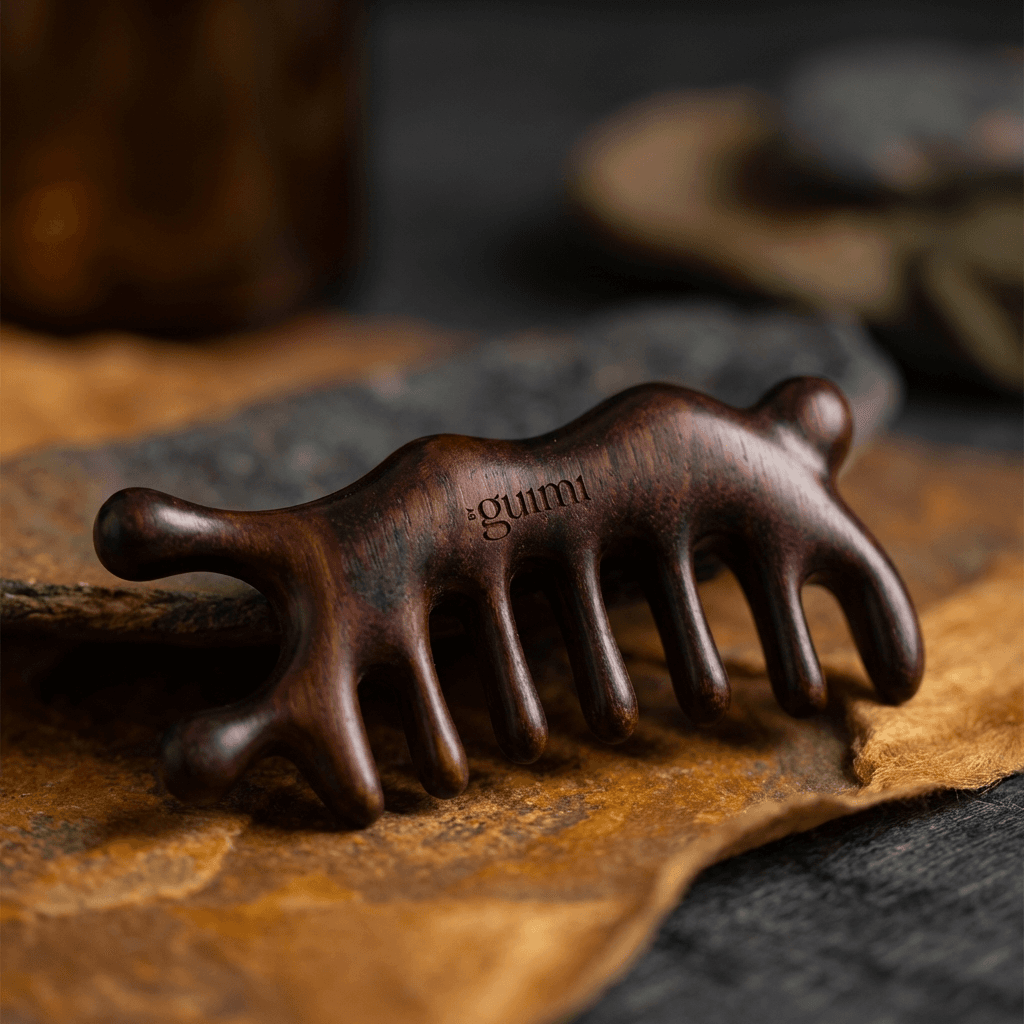
At by guimi we're more interested in the honest version of these traditions than the mystical marketing one, which is also why we're as happy with a simple sandalwood comb on the face as with a stone. Our notes are where we dig into the real stories.
FAQ
What does "gua sha" literally mean? "Scrape sha" - 刮 to scrape, 痧 the red marks it raises on the body in the traditional form.
Is facial gua sha the same as the traditional practice? It's a gentle modern descendant the same name and tools, far less pressure, and no marks.
Do I need a jade tool? No. Jade and rose quartz are traditional and pleasant to use, but a smooth edge and a light hand are what actually matter. (This is a comfort ritual; we make no medical claims.)