What is a Chinese beauty ritual?
A guide to Chinese beauty rituals — what separates a ritual from a trend, and a 5-minute morning face and neck routine you can start today.
Rituals
Chinese beauty ritual is a small, deliberate act of care - usually a little massage, a little warmth, and one well-made object, done at the same point in your day, on purpose. The gesture matters as much as the result. And the thing that really sets it apart from everything else in your bathroom isn't what's inside it. It's that a ritual is built to stay, while most beauty is built to be replaced.
I grew up between China and Germany, and for a long time I didn't have a word for the things my mother did. They weren't "wellness." They weren't a routine anyone was trying to optimize. They were just… what you did, in the morning, with your hands. It took moving away to notice that those small acts had quietly outlasted every product I'd ever been sold.
The object stays
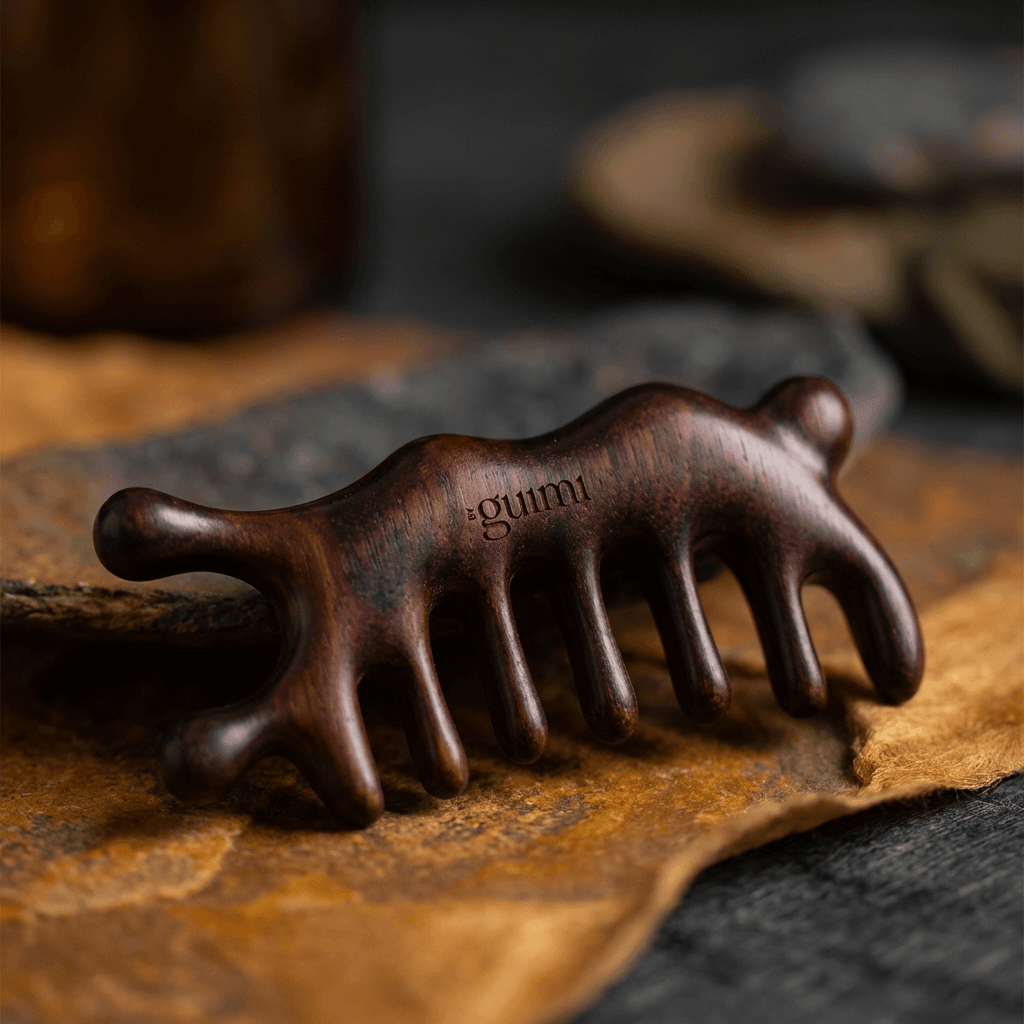
The clearest tell is the object. A serum gets finished and thrown away, and you buy the next one. A sandalwood comb does the opposite: It darkens over the years with the oil from your hands, until it looks like it belongs to you. A jade ring takes a slow polish from being worn. Things that age with you get treated differently from things you use up. That difference is most of what the word "ritual" is doing here.
A ritual, or a trend?
One useful question here is: Will I still be doing this in three years?
That's really the line between a ritual and a trend. A trend is exciting because it's new - it's having a moment, everyone's holding the same tool, and by next season there's a different one. A ritual is the quiet opposite. It isn't having a moment. It survived the moment.
| A trend | A ritual | |
| What drives it | Newness: It's having a moment | Repetition: It survives the moment |
| The object | Hyped, then replaced next season | Kept, and ages with you |
| The pace | Fast - you're chasing the next one | Slow - slow is the point |
| How you judge it | By the before-and-after | By how the morning felt |
| Where it came from | A feed, this month | A grandmother, several generations back |
| When life gets hard | First thing to go | The half that survives a bad week |
None of this makes trends bad. Trends are how you find things - I've discovered plenty I now love because they were briefly everywhere. A ritual is just what's left over once the excitement fades, if the thing was actually good enough to keep. Most of us live with both. The ritual is simply the half that survives a bad week - the two minutes you still do when you're tired, sad, travelling, or uninspired, because by then it isn't a task anymore. It's just yours.
How to tell if something will become a ritual
A few signs, if you're wondering whether a new thing will actually last: (1) you reach for it without deciding to; (2) the object is getting better with age, not worse; (3) you'd be a little sad to lose it; (4) it takes longer than it strictly "needs" to, and you don't mind; (5) you can't quite explain the benefit on a label, but you know how it makes the morning feel. If most of those are true, you have a ritual. If not, you might just be having a lovely moment with a trend - and that's completely fine too.
What does a five-minute Chinese morning routine look like?
Six steps, all of them above the collarbone: warm your hands, press the inner corners of the brows, sweep outward under the eyes, release the jaw and temples, then take everything down the side of the neck. The whole sequence works with bare fingers, or with the rounded tip of a comb once you have one. Finish with a glass of warm water, which is the part everyone leaves out.
1
Warm your hands (15 seconds)
Rub your palms together until they are properly warm, then rest them over your closed eyes and breathe out once. My mother did this before she touched her face and I still do it without thinking. Cold hands make you flinch; warm hands make you slow down, which is the whole point of the next four minutes.
2
Press the inner corners (30 seconds)
Find the small dip at the inner corner of each eye, right where the bridge of the nose meets the brow bone. Rest your ring fingers there and hold a gentle pressure for five slow breaths. This point is called 睛明 (jīng míng), and in Chinese households it is the first place you go for tired eyes, long before anything gets rubbed on them.
3
Sweep outward under the eye (1 minute)
With your ring finger, or the rounded tip of the snail comb, glide from the inner corner along the bone under your eye and out towards the temple. Keep it light enough that the skin does not drag or bunch; you are moving fluid, not stretching skin. Always outward, never back and forth, about ten passes each side.
4
Release the jaw and temples (1 minute 30)
Move to the hinge of your jaw, just below the ears, and make small slow circles there. Then up to the temples, then along the brow line, same pressure. This is where most of us store a night of clenching, and it is usually the step people feel the most.
5
Take it down the neck (1 minute)
Sweep from just behind your ear down the side of your neck to the collarbone, five or six times each side, always downward. This is where the fluid you have just moved actually goes. It is the step almost everyone skips, and skipping it is why a face massage can feel like it did nothing.
6
Warm water, then go (30 seconds)
A glass of plain warm water, 温开水, before coffee and before anything else. I am not going to make a dramatic claim for it. It is simply how the morning begins in most Chinese homes, and it closes the ritual in a way a cold tap somehow does not.
If you only have sixty seconds
Do step three and step five. Outward under the eye, then down the neck. That pairing is the whole mechanism in miniature, and one minute done every morning will always beat ten minutes done when you happen to remember.