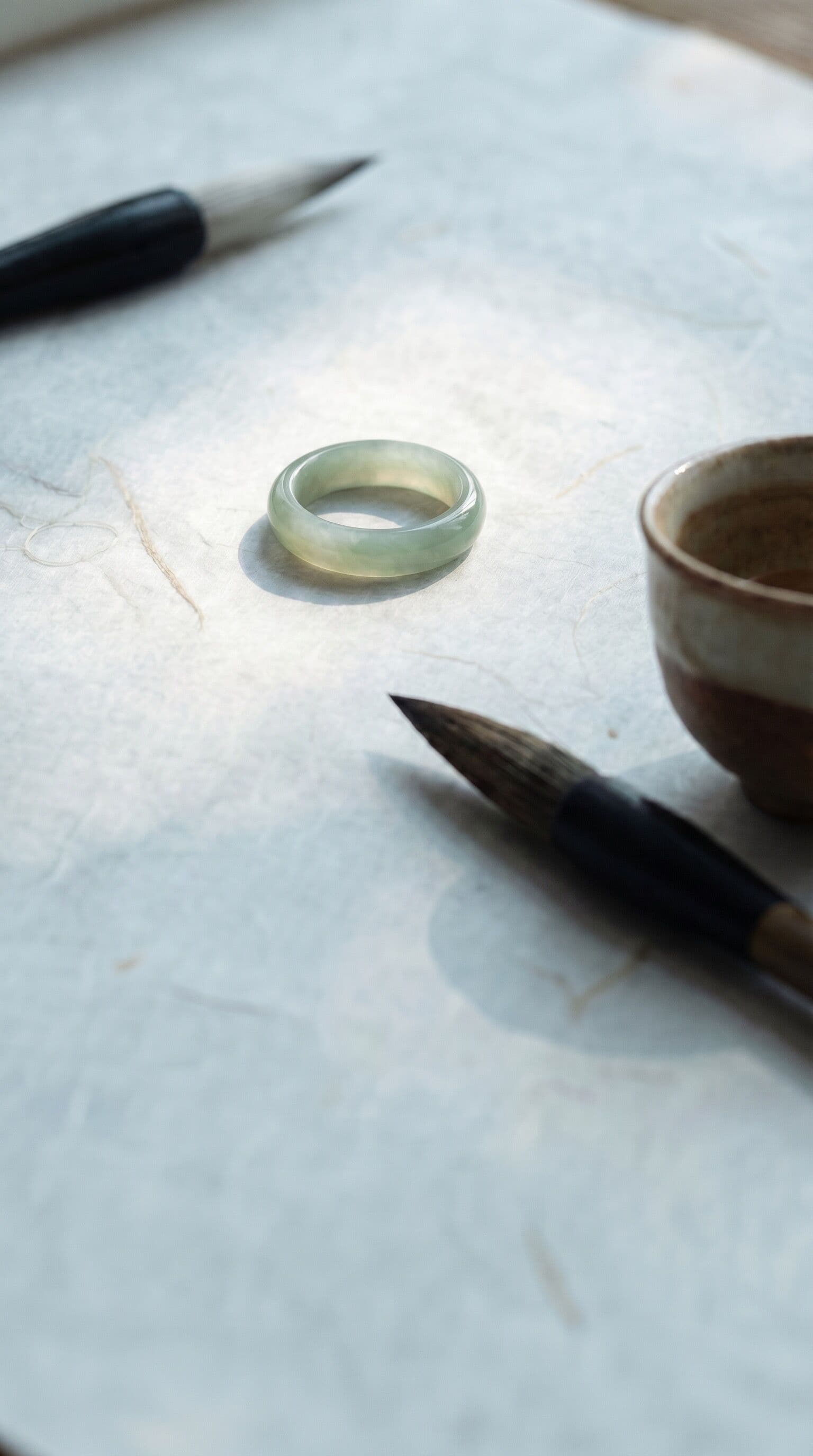
What is the significance of jade in China?
In China, jade stands for integrity, protection and continuity - the stone you're given, not bought. Bangles, peace discs, pendants: what each form means.
Chinese culture
In Chinese culture, jade is the stone that carries meaning rather than status. It stands for integrity, protection and continuity, which is why it turns up at births, weddings and graduations, and when someone is moving far from home. Gold is what you buy. Jade is what you are given.
Why does jade matter so much in Chinese culture?
Jade matters because it was never only decorative. From the Neolithic onwards it was the material of ritual and burial, and by the Confucian period it had become the standard image for personal character: the Book of Rites (礼记) has the gentleman comparing his own virtue to jade. That is the through line, and it is why a jade piece reads as a statement about a person rather than about money.
None of that history gets said out loud in a Chinese home. The stone is simply there: on a wrist at the dinner table, under a school shirt on a red cord, in a drawer waiting for someone to be old enough for it. The meaning transmits through the wearing rather than through anyone explaining it. On Little Red Note (小红书) you see the same thing in a different register, people posting their 'family treasures' (传家宝), the family piece, usually next to a photo of a much older wrist.
黄金有价,玉无价 (Gold has a price, jade does not) - It is the line people reach for when someone asks what a piece cost, and it is a polite way of saying that isn’t the question. Two rings cut from the same boulder can be worth very different amounts, and the one that matters is usually the one that came from a person.
What do the different jade pieces mean?
Jade is worn in a handful of set forms, and each form carries a different wish. A bangle (手镯) is the family piece, usually given by an older woman and rarely taken off; a peace disc (平安扣) is given for safe passage; a ring is the modern everyday piece; and a carved pendant carries whatever its motif means. Knowing the form tells you as much as knowing the stone.
| Piece | Who wears it | What it carries |
| Bangle 手镯 | Women, usually given by a mother or grandmother | Family continuity and protection. Sized not to slip off, so it mostly stays on |
| Ring 戒指 | Anyone, at any age | The modern everyday piece. No fixed conventions, which is why it travels well |
| Peace disc 平安扣 | Anyone, often someone travelling or moving away | 平安, safe and well. A smooth disc echoing the ancient 璧 (bì) disc |
| Pendant on a red cord 玉佩 | Children and adults, worn under the shirt | Whatever its carving means. Kept against the skin rather than displayed |
| Longevity lock 长命锁 | Babies, at a first month or a first birthday | A long life, symbolically locked in. Usually silver, sometimes jade |
| Guanyin or Buddha carving | 男戴观音,女戴佛: men Guanyin, women Buddha | Calm and patience for the wearer. A folk convention, not a religious rule |
The Chinese names are what these are actually called, on 小红书 as much as anywhere else. None of the associations are rules. They are the conventions families tend to follow, and plenty of people happily ignore them.
The forms also sort by life stage, which is the part that surprises people. A lock goes on a baby, a small pendant goes on a child, a ring is what you buy yourself in your twenties, and a bangle is what arrives when someone decides you are ready to keep something. That last one is rarely announced in advance. It just appears, usually at a meal, usually from a wrist that has worn it for decades.
How is jade given as a gift, and what is said?
Jade is given quietly. It arrives at a beginning: a birth, a wedding, an eighteenth birthday, a move abroad, and the words that go with it are almost always some version of 平安 (píng’ān), safe and well. Nobody makes a speech, and nobody mentions what it cost.
Usually it is put on you rather than handed over in a box. Someone takes your hand, works the bangle over the knuckle, turns it once to sit right, and the conversation moves on to something else. What gets said is short, 戴着吧, just wear it, and the meaning lives in the wearing rather than in the sentence. If you are the one receiving it, the thing to do is put it on soon and be seen in it. Jade kept in a drawer is the only outcome that would genuinely disappoint the person who gave it to you.
红绳, the red cord
Pendants hang on red thread rather than a chain, and the cord is the part designed to wear out. It gets replaced every year or two, often around new year, and nobody treats that as significant. The stone is what continues. If you have ever wondered why the cord on an old family piece looks newer than the piece, that is why.
FAQ
- Where does the English word “jade” come from?
From Spanish, and from a misunderstanding. Early Spanish explorers in Central America saw people holding the stone against their sides for aches and named it piedra de ijada, stone of the pain in the side, which came into English as jade.
So the English word carries a folk-medical idea from the other side of the world, while the Chinese word 玉 carries a moral one. The two traditions were never talking about the same thing.
- Is 翡翠 (feicui) just another word for jade?
No, and the distinction is useful when you are buying. 玉 is the general word and covers both minerals. 翡翠 means jadeite specifically, named after the kingfisher, with 翡 for the red feathers and 翠 for the green.
A Chinese seller will always tell you which of the two you are looking at, because the price bands are completely different. If someone uses the words interchangeably, ask again.
- Why is jade always carved and polished rather than cut with facets?
Because of what the stone is. Jade is a dense mass of interlocking crystals rather than a single transparent crystal, so it has no clean planes to split along and nothing for facets to do. Light does not travel through it in straight lines, it diffuses.
What that structure gives you instead is exceptional toughness and a soft internal glow, which is why jade has always been shaped into curves and worn against skin rather than set up to sparkle.
- Does jade have healing properties?
No. There is no evidence that jade affects health, and we will never tell you otherwise. Anything you read about jade drawing out illness, balancing energy or detoxifying anything is folk belief or marketing, and the two are increasingly hard to tell apart online.
What is real is small and physical: jade conducts heat well, so it feels cool going on and warms to your skin within seconds, and it is tough enough to be worn every day for decades. That, plus what it has meant for five thousand years, is the whole offer.
Five thousand years, worn on a wrist
Nothing in this history asks to be believed. It only asks to be worn, which is the one thing jade has consistently been for since a Liangzhu craftsman spent a month grinding a disc by hand. Jade No. 01 is our first ring, cut from genuine natural jade and made for daily wear rather than for a cabinet. It opens to the waitlist first.